Saturday, 13 May 2017


The Lotus Buddha IV
The painting depicts the meditation Buddha or the Lotus Buddha as Buddha in this position resembles a lotus flower. The lotus besides being a symbol of purity was also the symbolic vehicle that led the Buddha to Nirvana. The Lotus Buddha has the hands resting gently on the lap while the legs are crossed. This position is commonly used for meditation and is known as the lotus position. The lotus flower is rich with symbolic meaning in Buddhism. It is a symbol of Bodhi, a state of spiritual perfection and complete mental purity, the pacification of our base nature.

Acrylic on canvas 36" X 48"
Status: Unavailable 

The Lotus Buddha VI
The painting depicts the meditation Buddha or the Lotus Buddha as Buddha in this position resembles a lotus flower. The lotus besides being a symbol of purity was also the symbolic vehicle that led the Buddha to Nirvana. The Lotus Buddha has the hands resting gently on the lap while the legs are crossed. This position is commonly used for meditation and is known as the lotus position. The lotus flower is rich with symbolic meaning in Buddhism. It is a symbol of Bodhi, a state of spiritual perfection and complete mental purity, the pacification of our base nature. 
Acrylic on canvas 36"X 48"
Status: Available via Gallery Artistique

Tuesday, 2 May 2017


Dhyana I ( Tiger and the meditating monk) 
In this work the tiger represents the mind in all its power and untamed ferocity with the random unformed script-like forms representing scattered thoughts. Through the power of meditation the monk seemingly brings this "chanchal" mind under control. The contrast of the tigers ferocity highlights the calmness of the monk- just as it takes some hardships for us to appreciate the good that lies within. The retention of calmness in a tumultuous environment is achieved through Dhyana, the practice of mind control by which we stop all thinking  and seek to realise Truth in its essence. The dot in the work depicts this focusing of the mind. Of the many different paths to Nirvana, the most important one  is the path of Dhyana, the practice of “stopping and realising.”

Mixed media on canvas 40" X 30"   
Acquired


Dhyana II ( Bodhi tree and the four boy monks) 
Selected for the AIFACS 86th All India Annual Exhibition/ December 2013

In this work the novice boy monks are revealed the concept of "Nirvana" as depicted by the tree in its purest form of monochromatic representation. The novice monks are in awe of this magnificent vision. They see the path that links them to their final goal through Dhyana, represented by the simple red dot. The sanctity and purity of this thought lies in the vast whiteness of the canvas. As one pauses to absorb the work, the artist endeavours to instil The retention of calmness in the midst of a  tumultuous environment that the viewer may find himself in. It is  through Dhyana, the practice of mind control by which we stop all thinking and seek to realize Truth in its essence. Of the many different paths to Nirvana, the most important one  is the path of Dhyana, the practice of “stopping and realizing.”
Mixed media on canvas 48" X 36"   
Acquired via Gallerie Nvya  
Selected for AIFACS 86th All India Annual Exhibition, Delhi
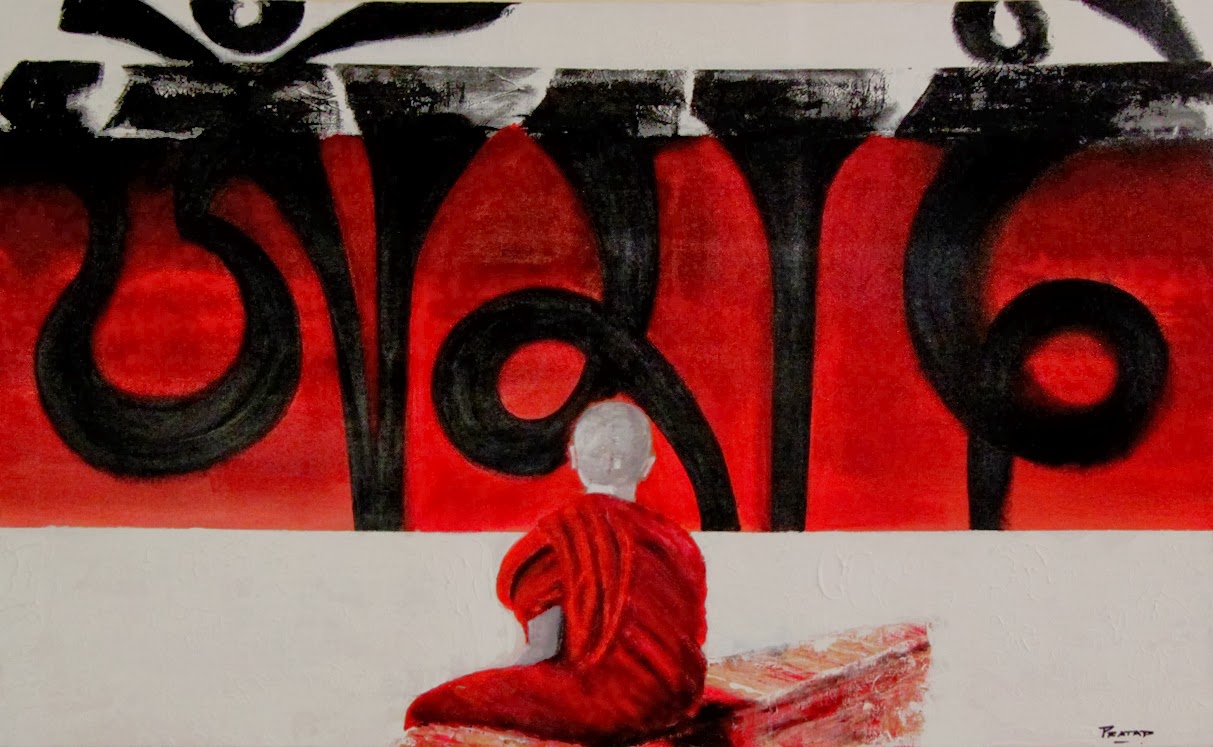
Dhyana III (boy monk on wall) 
The mantra Om mani padme hum as presented in the artwork is deep and vast in its resonance and meaning.  The six syllables, om mani padme hum, mean that with the practice of the path which is an indivisible union of method and wisdom, the impure body, speech, and mind can be transformed into the pure exalted form of the Buddha. The chant rises upwards as a tribute to the Buddha. The boy monk sits on a wall contemplating the immense meaning of the chant resolvoing to conquer fear on his path to wisdom. 
Mixed media on canvas 48" X 36"   
Acquired via Gallerie Nvya
Dhyana IV
In the work, the artist depicts the swirling random movement of the mind and uncontrolled circumstances that surround us, every moment, often dictating our actions. Thus we react to all that we are surrounded by and enveloped in. The monk is also therefore in a similar situation but appears to emerge out of it, retaining his serenity which is reflected by his posture. This retention of calmness in a tumultuous environment is achieved through Dhyana, the practice of mind control by which we stop all thinking and seek to realize Truth in its essence. Of the many different paths to Nirvana, the most important one  is the path of Dhyana, the practice of “stopping and realizing.”
Mixed media on canvas (36" X 36" Framed) / 2013
Acquired

Dhyana VI
In the work, the artist depicts the swirling random movement of the mind and uncontrolled circumstances that surround us, every moment, often dictating our actions. Thus we react to all that we are surrounded by and enveloped in. The monk is also therefore in a similar situation but appears to emerge out of it, retaining his serenity which is reflected by his posture. This retention of calmness in a tumultuous environment is achieved through Dhyana, the practice of mind control by which we stop all thinking and seek to realize Truth in its essence. Of the many different paths to Nirvana, the most important one  is the path of Dhyana, the practice of “stopping and realizing.”
Mixed media on canvas (36" X 36" Framed) / 2013
Unavailable 

Dhyana VII - Asthachal, the evening meditation
As the sun sets and the mountain air turns cold, it is time to find peace within one's self simply by focussing on the spectacular sunset, the silence that envelopes and the smells of pine and wood smoke. The artist has attempted to capture this memory on his canvas in the hope of sharing the tranquillity with all who may enjoy the work.

Mixed media on canvas 36" X 48" / 2013
Status: Acquired
 
Dhyana VIII
As the sun sets it is time to find peace within one's self simply by focussing on the spectacular sunset, the silence that envelopes. The artist has attempted to capture this memory on his canvas in the hope of sharing the tranquillity with all who may enjoy the work. 
Acrylic on canvas 60" X 40"
Acquired via Gallerie Nvya

Dhyana IX
In the work, the artist depicts the swirling random movement of the mind and uncontrolled circumstances that surround us, every moment, often dictating our actions. Thus we react to all that we are surrounded by and enveloped in. The monk is also therefore in a similar situation but appears to emerge out of it, retaining his serenity which is reflected by his posture. This retention of calmness in a tumultuous environment is achieved through Dhyana, the practice of mind control by which we stop all thinking and seek to realize Truth in its essence. Of the many different paths to Nirvana, the most important one  is the path of Dhyana, the practice of “stopping and realizing.”
Acrylic on canvas (50" X 36" Diptych) 
Acquired via Veranda Art

Moksha - the liberation 
Moksha (Sanskrit for liberation) or mukti (Sanskrit for release) is liberation from 'samsara', the cycle of death and rebirth or reincarnation and all the suffering and limitation of worldly existence. It is a state of absolute freedom, peace and bliss attained through self-realisation.This is the supreme goal of human endeavour. It is seen as a transcendence of phenomenal being, a state of higher consciousness, in which matter, energy, time, space, karma (causation) and the other features of empirical reality are understood as 'maya' or an illusion that anchors one to the materialistic.

In this work the tree represents this self realisation and is seemingly aglow with the bliss of liberation from our limitations of worldly existence. The tree itself rises from the darker shades of 'Maya' even as the monk endeavours to achieve this supreme goal through the practice of 'Dhyana'.
Mixed media on canvas (36 X 48)
Acquired

Series: Miscellaneous works

Monday, 1 May 2017


Kashi I
Varanasi derives its name from the two rivers that flank the city, the Varuna to the north and the Asi to the south. However, pilgrims refer to it as Kashi, first used three thousand years ago to describe the kingdom and the city outside which the Buddha preached his first sermon; the "City of Light" is also called Kashika, "the shining one", referring to the light of Shiva. Another epithet, Avimukta, meaning "Never Forsaken", refers to the city that Shiva never deserted. Also referred to as Rudravasa, the place where Shiva (Rudra) resides, Kashi's associations with Shiva extend to the beginning of time: legends relate how, after his marriage to Parvati, Shiva left his Himalyan abode and came to reside in Kashi with all the gods in attendance. Temporarily banished during the rule of the great king Divodasa, Shiva ultimately returned to his rightful abode protected by his loyal attendants Kalabhairav and Dandapani. Over 350 gods and goddesses, including a protective ring of Ganeshaa form a mandala or sacred pattern with Shiva Vishwanatha at its centre.
Mixed media on canvas (54" X 36") 
Acquired via Gallerie NVYA

Kashi II
Varanasi derives its name from the two rivers that flank the city, the Varuna to the north and the Asi to the south. However, pilgrims refer to it as Kashi, first used three thousand years ago to describe the kingdom and the city outside which the Buddha preached his first sermon; the "City of Light" is also called Kashika, "the shining one", referring to the light of Shiva. Another epithet, Avimukta, meaning "Never Forsaken", refers to the city that Shiva never deserted. Also referred to as Rudravasa, the place where Shiva (Rudra) resides, Kashi's associations with Shiva extend to the beginning of time: legends relate how, after his marriage to Parvati, Shiva left his Himalyan abode and came to reside in Kashi with all the gods in attendance. Temporarily banished during the rule of the great king Divodasa, Shiva ultimately returned to his rightful abode protected by his loyal attendants Kalabhairav and Dandapani. Over 350 gods and goddesses, including a protective ring of Ganeshaa form a mandala or sacred pattern with Shiva Vishwanatha at its centre.
Acrylic on canvas (44" X 14") 
Acquired via Gallerie NVYA

Kashi III

Varanasi derives its name from the two rivers that flank the city, the Varuna to the north and the Asi to the south. However, pilgrims refer to it as Kashi, first used three thousand years ago to describe the kingdom and the city outside which the Buddha preached his first sermon; the "City of Light" is also called Kashika, "the shining one", referring to the light of Shiva. Another epithet, Avimukta, meaning "Never Forsaken", refers to the city that Shiva never deserted. Also referred to as Rudravasa, the place where Shiva (Rudra) resides, Kashi's associations with Shiva extend to the beginning of time: legends relate how, after his marriage to Parvati, Shiva left his Himalyan abode and came to reside in Kashi with all the gods in attendance. Temporarily banished during the rule of the great king Divodasa, Shiva ultimately returned to his rightful abode protected by his loyal attendants Kalabhairav and Dandapani. Over 350 gods and goddesses, including a protective ring of Ganeshaa form a mandala or sacred pattern with Shiva Vishwanatha at its centre.
Mixed media on canvas (48" X 45") 
Acquired 
Kashi V
Varanasi derives its name from the two rivers that flank the city, the Varuna to the north and the Asi to the south. However, pilgrims refer to it as Kashi, first used three thousand years ago to describe the kingdom and the city outside which the Buddha preached his first sermon; the "City of Light" is also called Kashika, "the shining one", referring to the light of Shiva. Another epithet, Avimukta, meaning "Never Forsaken", refers to the city that Shiva never deserted. Also referred to as Rudravasa, the place where Shiva (Rudra) resides, Kashi's associations with Shiva extend to the beginning of time: legends relate how, after his marriage to Parvati, Shiva left his Himalayan abode and came to reside in Kashi with all the gods in attendance. Temporarily banished during the rule of the great king Divodasa, Shiva ultimately returned to his rightful abode protected by his loyal attendants Kalabhairav and Dandapani. Over 350 gods and goddesses, including a protective ring of Ganeshaa form a mandala or sacred pattern with Shiva Vishwanatha at its centre.
Acrylic on canvas (50" X 18") / Framed
Status: Available
Kashi VI
Varanasi derives its name from the two rivers that flank the city, the Varuna to the north and the Asi to the south. However, pilgrims refer to it as Kashi, first used three thousand years ago to describe the kingdom and the city outside which the Buddha preached his first sermon; the "City of Light" is also called Kashika, "the shining one", referring to the light of Shiva. Another epithet, Avimukta, meaning "Never Forsaken", refers to the city that Shiva never deserted. Also referred to as Rudravasa, the place where Shiva (Rudra) resides, Kashi's associations with Shiva extend to the beginning of time: legends relate how, after his marriage to Parvati, Shiva left his Himalyan abode and came to reside in Kashi with all the gods in attendance. Temporarily banished during the rule of the great king Divodasa, Shiva ultimately returned to his rightful abode protected by his loyal attendants Kalabhairav and Dandapani. Over 350 gods and goddesses, including a protective ring of Ganeshaa form a mandala or sacred pattern with Shiva Vishwanatha at its centre.
Acrylic on canvas (50" X 18") / Framed
Status: Available via Gallery Artistique

Kashi VIII
Varanasi derives its name from the two rivers that flank the city, the Varuna to the north and the Asi to the south. However, pilgrims refer to it as Kashi, first used three thousand years ago to describe the kingdom and the city outside which the Buddha preached his first sermon; the "City of Light" is also called Kashika, "the shining one", referring to the light of Shiva. Another epithet, Avimukta, meaning "Never Forsaken", refers to the city that Shiva never deserted. Also referred to as Rudravasa, the place where Shiva (Rudra) resides, Kashi's associations with Shiva extend to the beginning of time: legends relate how, after his marriage to Parvati, Shiva left his Himalyan abode and came to reside in Kashi with all the gods in attendance. Temporarily banished during the rule of the great king Divodasa, Shiva ultimately returned to his rightful abode protected by his loyal attendants Kalabhairav and Dandapani. Over 350 gods and goddesses, including a protective ring of Ganeshaa form a mandala or sacred pattern with Shiva Vishwanatha at its centre.
Acrylic on canvas (36" X 36") 
Status: Not available 
Kashi  IX
Varanasi derives its name from the two rivers that flank the city, the Varuna to the north and the Asi to the south. However, pilgrims refer to it as Kashi, first used three thousand years ago to describe the kingdom and the city outside which the Buddha preached his first sermon; the "City of Light" is also called Kashika, "the shining one", referring to the light of Shiva. Another epithet, Avimukta, meaning "Never Forsaken", refers to the city that Shiva never deserted. Also referred to as Rudravasa, the place where Shiva (Rudra) resides, Kashi's associations with Shiva extend to the beginning of time: legends relate how, after his marriage to Parvati, Shiva left his Himalyan abode and came to reside in Kashi with all the gods in attendance. Temporarily banished during the rule of the great king Divodasa, Shiva ultimately returned to his rightful abode protected by his loyal attendants Kalabhairav and Dandapani. Over 350 gods and goddesses, including a protective ring of Ganeshaa form a mandala or sacred pattern with Shiva Vishwanatha at its centre. 

Acrylic on canvas (36" X 72") 
Acquired via Art For Concern

Basant Kashi

Varanasi derives its name from the two rivers that flank the city, the Varuna to the north and the Asi to the south. However, pilgrims refer to it as Kashi, first used three thousand years ago to describe the kingdom and the city outside which the Buddha preached his first sermon; the "City of Light" is also called Kashika, "the shining one", referring to the light of Shiva. Another epithet, Avimukta, meaning "Never Forsaken", refers to the city that Shiva never deserted. Also referred to as Rudravasa, the place where Shiva (Rudra) resides, Kashi's associations with Shiva extend to the beginning of time: legends relate how, after his marriage to Parvati, Shiva left his Himalyan abode and came to reside in Kashi with all the gods in attendance. Temporarily banished during the rule of the great king Divodasa, Shiva ultimately returned to his rightful abode protected by his loyal attendants Kalabhairav and Dandapani. Over 350 gods and goddesses, including a protective ring of Ganeshaa form a mandala or sacred pattern with Shiva Vishwanatha at its centre.

Mixed media on canvas (48" X 20") 
Status: Available via Artistique / The Oberoi Gurgaon

Sunday, 30 April 2017


Quiet the mind - and the soul will speak 
Meditation leads to experiencing the centre of consciousness within. It's a science and not a part of any religion. The work depicts a meditating form surrounded by what can be interpreted as temples of worship.
Acrylic on canvas 48" X 36"
Status: Available 
Series: Miscellaneous works

Monday, 13 February 2017


The Temple Guardian - Mahashaktimaya The bull, is of significance in many ancient cultures. In Buddhism, The Bull represents "desire" during the life of the Buddha as a prince. Amongst the Jains The bull is the emblem of Adinath, the first Jain tirthankara. In Greek mythology it is a symbol of male sexuality, illustrated by Zeus, in the form of a white bull, unrelentingly pursuing Europa.
In this work the Dumru, represented within the Shiva symbol of the Lingam, is significant in the mythology and character of the God. It was the rhythm of the Dumru to which Shiva began his dance of creation of the world, in the nothingness, endless void of space. Interestingly the Dumru is also believed to symbolise and represent the Far Eastern Asian concept of the Ying and the Yang of creation wherein the shape of the Dumru symbolises the alliance between the two complimentary forces of co-creation in the universe...the Divine Feminine (Yin) where the downward representation symbolizes the Yoni)and the Divine Masculine (Yang). or the male portion of the Damaru which symbolizes the Lingam. Hence, the creation of the world begins when the lingam and yoni meets at the mid-point of the Damaru, and the destruction takes place when both separate from each other.
Acrylic on canvas 50" X 24"   
Acquired via Art For Concern

The Temple Guardian - Akshayaguna
The bull, is of significance in many ancient cultures. In Buddhism The Bull represents "desire" during the life of the Buddha as a prince. Amongst the Jains The bull is the emblem of Adinath, the first Jain Tirthankara. In Greek mythology it is a symbol of male sexuality, illustrated by Zeus, in the form of a white bull, unrelentingly pursuing Europa.
Within Hinduism, the bull is best known as Nandi, the sacred steed of Shiva and is depicted as a powerful white bull. The white colour is a symbol of purity and devotion. Nandi is regarded as the gatekeeper and protector of Shiva as well as Shiva’s consort the Hindu Goddess Parvati and It is believed that one must first gain the approval of Nandi before being allowed to worship Lord Shiva.

In this work the vivid crimson hues in the background and the thickness of the layering is inspired by the Pashupatinath Temple in Kathmandu where in the sanctum sanctorum  vermillion applied by devotees is never wiped away but simply allowed to collect layer upon layer. The work depicts the guardian of the abode in the foreground significantly superimposed on the golden lingam shape. Allegory to Buddhist links of Shiva, known as Lha Chen is portrayed by the lotus flowers and the Tibetan Buddhist script for the all prevailing 'OM".
Acrylic on canvas 50" X 24"  
Acquired

Wednesday, 18 January 2017


On Hallowed Ground III
Hallowed ground is a term used for a sacred place. It is a place that is considered to be highly venerated and sacrosanct and is usually blessed by a priest or a monk. In this work the artist tries to capture on canvas the sanctity of the hallowed ground by depicting the devotee bowing and hence showing his submission to the will of God and of his being a true believer. The work portrays unquestioning, undying devotion. 
Acrylic on canvas 48" X 36"  
Acquired via Saatchi Art

On Hallowed Ground I

Hallowed ground is a term used for a sacred place. It is a place that is considered to be highly venerated and sacrosanct and is usually blessed by a priest or a monk. In this work the artist tries to capture on canvas the sanctity of the hallowed ground by depicting the devotee bowing and hence showing his submission to the will of God and of his being a true believer. The work portrays unquestioning, undying devotion. 
Mixed media on canvas 48" X 36"   
Acquired via TAD Arts 

On Hallowed Ground II
Hallowed ground is a term used for a sacred place. It is a place that is considered to be highly venerated and sacrosanct and is usually blessed by a priest or a monk. In this work the artist tries to capture on canvas the sanctity of the hallowed ground by depicting the devotee in deep prayer showing his submission to the will of God and of his being a true believer. The work portrays unquestioning, undying devotion. 
Mixed media on canvas 48" X 36"
Status: 
Available via Art Houz / Part of Affordable Art Fair Singapore 2016 

Sunday, 6 November 2016


Across Faiths - Crusades
Crusades have existed right across faiths and times in some form or the other. This work has been inspired by a trip to Spain. Many knights went on the Crusades to bring themselves fame and glory in the old tradition of chivalry; a few went solely to make their fortune, but the vast majority of Crusaders went on the journey for reasons of faith — in religious devotion, to obtain absolution or remission of sins, and be granted salvation in the afterlife. That belief continues to this day.

Acrylic on canvas 50" X 18" Framed
Status: Not available

Across Faiths - Cardoba
Work inspired by visit to Cordoba, Spain
A magnificent example of moorish and renaissance architectures the mezquita or the cathedral of Cordoba also known as the great mosque speaks to the artist of sentiments beyond the awe inspiring structure. Started as a church of St Vincent it "changed faiths" with conquests over the ages, and at point of time was divided between two faiths! At each turn architectural additions have led to the fantastic structure that it is... but the changes and the show of power and domination, the war for a place to pray, to the artist seems to be an act in futility of epical magnificence which has been witnessed across time, geographies, and beliefs. The mezquita is one outstanding example of the powerful, building, destroying and rebuilding a structure in the name of that one omnipresent being who resides within each! Why is faith to have a structure and form, a place and a time?

Acrylic and mixed media on canvas 50" X 18"
Acquired from Art Bengaluru

Monday, 24 October 2016


Celebrating the Chandrabindu VII
The work is a result of the artist's fascination of the devanagari script's chandra bindu derivatives of which are found in the Tibetan umê and Uchen scripts, Bhutanese Dzongka,and Sikkimese Drendzongké amongst other Sino Tibetic scripts around central Asia. Some believe, the ' Moon -Dot' to be a protective bowl cradling the soul, and  that the crescent and dot represents the land of the perfect soul. The chandra bindu also reminds the artist of the crescent moon and star symbol which transcends cultures.

Ofcourse the chandrabindu is intrinsic to the famous and sacred Aum where it is believed to represent Vishnu. Interpretations of the symbol of ॐ (aum) containing three curves, one semicircle and a dot is that the large lower curve symbolizes the waking state; the upper curve denotes deep sleep (or the uncon-scious) state, and the curve between the two (which lies between deep sleep and the waking state) signifies the dream state. Coming to the Chandrabindu, the dot signifies the Absolute (fourth or Turiya state of consciousness), the semicircle symbolizes "maya" and separates the dot from the other three curves. The semi-circle is open on the top, which means that the absolute is infinite and is not affected by maya.

In the view of the artist, the Sacred Aum (the vibrant resonance of which has deep connotations and significance in the creation of the world) is incomplete in its very essence without the Chandrabindu.

Size 36 X 48 // Acrylic on canvas
Status: Available 

Thursday, 4 August 2016


At the threshold II
The threshold of a monastery is a sacred spot. It is a place that is considered to be highly venerated and sacrosanct for it is this place that marks the start of a journey of reverence and veneration.  In this work the artist tries to capture on canvas the sanctity of the threshold... the crossing of the inner barrier to a deeper spiritual revelation. Crossing the threshold depicts the submission to the will of God and of his being a true believer. The work portrays unquestioning, undying devotion. The door awaits as though urging one to push open and enter this sacred space.

Mixed media on canvas DIPTYCH 
Status: Acquired via Gallerie Nvya

At the threshold I
The threshold of a monastery is a sacred spot. It is a place that is considered to be highly venerated and sacrosanct for it is this place that marks the start of a journey of reverence and veneration.  In this work the artist tries to capture on canvas the sanctity of the threshold... the crossing of the inner barrier to a deeper spiritual revelation. Crossing the threshold depicts the submission to the will of God and of his being a true believer. The work portrays unquestioning, undying devotion. The door awaits as though urging one to push open and enter this sacred space.

Mixed media on canvas 48" X 36" (Framed)
Acquired via Gallerie Nvya

Saturday, 30 July 2016


Divine Resonance - Tang Du, the Tibetan prayer drum

A series in progress, depicted here by the Tibetan prayer drum that resonates evocative vibrations high into the cold and silent mountain air. The even beat reminds one of monks deep in meditation and the heavy smell of incense. The resonance reaches out to honour and pacify the protective God, Mahakala. 

Acrylic and pen on canvas 36" X 36"
Status: Acquired

Friday, 29 July 2016


Divine Resonance - the lute
Inspired by the pure sound of the lute the work tries to capture the essence of the sound and the sentiments that it evokes. The lute has been used across faiths as an allegory to emphasise and convey philosophies. For instance to motivate towards prayer the comparison is made to the  lute player as he is bending over the instrument, listening attentively, his fingers making the strings vibrate in harmony creating music that is soft and beautiful , much like the faithful  praying with body and the depths of their soul.
The Buddha spoke of the technique of meditation , by drawing attention to the strings of the lute which when neither too taut nor too loose, but adjusted to an even pitch, produced a wonderful sound and was easy to play, hence keeping the energy in balance to focus. The lute is also one of the symbols of the Five Qualities of  Enjoyment, symbolising the offering of the uncontaminated enjoyment of pure sounds.
Mixed media on canvas 56" X 20" Acquired via Art Houz / Affordable Art Fair Singapore 2016 

Saturday, 11 June 2016


Ramayana, The Lesser Heroes II - Jatayu 
Critical to the main story, but rarely spoken of, and never in the same hushed whispers of awed reverence as the protagonists, the series  attempts to highlight the lesser heroes of a magnificent epic, without whom the epic itself would have paled in its essence.
Presenting, a representation of Jatayu a Demi God in the form of a vulture who inspite of his old age, challenged and valiantly fought the antagonist, Ravana in a bid to stop him from successfully abducting Sita. With age being against him, he was no match and even while he lay dying pointed Rama, the protagonist to the south i.e. in the direction which Ravana had fled with Sita. 

The Epic has international reach and popularity - from the coasts of India to the shores of the Indonesian Islands (not just Hindu Bali). Hence characters have forms that are not necessarily ‘Indian’ in their appearance.

Acrylic on canvas 36" X 48"
Status: Acquired 

Ramayana, The Lesser Heroes II - Sugreeva
Critical to the main story, but rarely spoken of, and never in the same hushed whispers of awed reverence as the protagonists, the series  attempts to highlight the lesser heroes of a magnificent epic, without whom the epic itself would have paled in its essence. 

Sugreeva the monkey King and the general of the Vanar Sena that assisted in the victory over the evil antagonist. Sugreeva bravely attacks Kumbhakarna of the opposing forces with a tree trunk and is almost killed in the battle. 

The Epic has international reach and popularity - from the coasts of India to the shores of the Indonesian Islands (not just Hindu Bali). Hence characters have forms that are not necessarily ‘Indian’ in their appearance.

Acrylic on canvas 36" X 48" 
Status: Available via Art Houz Chennai

Friday, 10 June 2016


In her own shadow II

The work is reflective of the artists belief that in order to gain respect it is imperative to assert oneself. This is taken into perspective within the issue of women’s situation in the various social structures.

The work is a call to women and in a broader sense to all who seem discriminated against, basis gender, socially, psychologically, physically. We often let ourselves be discriminated against because we fail to recognise and assert our self esteem. How often do we take cognisance of that dark “being” that is integral to us and follows us around.... our shadow? To recognise the shadow and not allow it to consume and lead you, to come out of your own shadow and take flight, is the artist’s call to women through this work. The piercing eyes depict SHAKTI and hence the inherent power within each woman that gives her the strength to combat all odds and emerge from her own shadow.

Acrylic on canvas 36"X 36"
Status: Available

Tuesday, 7 June 2016


Faith I
The work is inspired by the daily assault that one observes on all that is held dearest by each.... an assault on basic rights, on principles of Humanity, on freedom of choice, on trust and on the very path that we select to journey on. To the artist these assaults seem formidable enough to  wilt the will and the  core of the individual and this work is an expression of resilience , a call to rally one's faith , an assurance that "we shall overcome". In spite of the laws of nature, and in the face of sceptics, the Lotus of faith in what we hold dear will bloom even in the impossibility of the dry, impenetrable rock. If the pond of serenity has been deprived our Lotus of faith shall seek the water of life from deep within even the rock.

Acrylic on canvas (40X36)
Acquired 

Series: Miscellaneous works

Monday, 6 June 2016


Flight III
It is that state of not being imprisoned and enslaved by thought, society, borders and all that is conformational that inspired this work. It is a call to arms for all and women in particular.
The artist creates traditional forms of beauty that are within the boundaries of so called ”acceptance“  but expresses his yearning to break free from the very frame of the work itself, as depicted by the Hummingbird , on a discovery beyond the boundary.
The bird represents resilience, and to the artist this translates into the ability to keep going emotionally, physically and above all spiritually. It seems to emphasise the ability to rise above troubles and hardships with ease and joy.

The woman, stands stripped off all adornments and in her natural beauty as if in defiance to being judged by others and bonded by the rules set for her. In a manner of speaking she is in “flight”. 
Acrylic on canvas 36" X 48"
Acquired

Flight II
It is that state of not being imprisoned and enslaved by thought, society,borders and all that is conformational that inspired this work. 

The artist creates traditional forms of beauty that are within the bars of acceptance but expresses his yearning to break free of the very framework of the work itself as depicted by the Hummingbird attempting to fly off the canvas itself on a discovery beyond the boundary.
The bird represents resiliency, and to the artist this translates into the ability to keep going emotionally, physically and above all spiritually. It seems to emphasise the ability to rise above troubles and hardships with ease and joy. 

Acrylic on canvas (48 X 36)
Status: Available 

Wednesday, 1 June 2016


Flight I
The Hummingbird is fascinating as even though it is one of the smallest it has the capabilities of travelling great distances and can fly in all directions even backwards and upside down. It can pick up speeds upto 25 km per hour and then stop suddenly on a coin. It needs to continuously feed off the nectar of flowers and hence has a strong relationship and dependency on them.

Hence the bird represents resiliency, and to the artist this translates into the ability to keep going emotionally, physically and above all spiritually. It seems to emphasise the ability to rise above troubles and hardships with ease and joy. For persons who have been through a lot in life it symbolises strength and moving way past and beyond just the threshold of overcoming trials. Hence representing an individual who loves and lives life to the fullest.


In several cultures it represents love, joy and hope. The Artist has attempted to translate this indomitable spirit on his canvas with the hope that it inspires and brings joy to all who view his work.

Acrylic on canvas 36" X 48"
Status: Unavailable 

Tuesday, 31 May 2016


Spandan II
The work attempts to capture “Creation” in its essence. The miracle that is life and the world on which it exists has a conceptual vastness difficult to comprehend in itself.When this spins back to that divine moment when nothingness was converted to a tangible, the mind needs to expand beyond any boundaries whatsoever, to even begin to conceptualise this phenomena. According to the Vedic philosophy of creation, the universe, which was set forth by the Spandana or vibration of the primal energy, Prakritri, has a sound symbol and that is “Om”. The symbol denoted in this painting is the Tibetan Om. It brings with it all the propitious attributes that are intrinsic to the act of creation.

Acrylic on canvas 40" X 60"
Acquired

Series: Miscellaneous works


Saturday, 28 May 2016


Bhiksham Dehi VIII
The alms bowl refers to the time in the Buddha’s life just before he attained enlightenment, when a young girl, named Sujata offered the Buddha a bowl of milk rice. Although the Buddha was practising austerity and eating only a little food at a time, he realised that to achieve the final stages of enlightenment, he would need to partake the offering of rice from Sujata. After partaking of the meal, the Buddha then threw away a small amount of food left in that bowl to symbolise non-attachment to material possessions. Another legend tells the story that the Buddha threw away the begging bowl itself into the river to symbolise this non-attachment.

Mixed media on canvas (48 X 36)
Acquired

Bhiksham Dehi VII
The alms bowl refers to the time in the Buddha’s life just before he attained enlightenment, when a young girl, named Sujata offered the Buddha a bowl of milk rice. Although the Buddha was practicing austerity and eating only a little food at a time, he realized that to achieve the final stages of enlightenment, he would need to partake the offering of rice from Sujata. After partaking of the meal, the Buddha then threw away a small amount of food left in that bowl to symbolize non-attachment to material possessions. Another legend tells the story that the Buddha threw away the begging bowl itself into the river to symbolize this non-attachment.

Mixed media on canvas (36 X 30)
Acquired

Bhiksham Dehi VI
The alms bowl refers to the time in the Buddha’s life just before he attained enlightenment, when a young girl, named Sujata offered the Buddha a bowl of milk rice. Although the Buddha was practicing austerity and eating only a little food at a time, he realized that to achieve the final stages of enlightenment, he would need to partake the offering of rice from Sujata. After partaking of the meal, the Buddha then threw away a small amount of food left in that bowl to symbolize non-attachment to material possessions. Another legend tells the story that the Buddha threw away the begging bowl itself into the river to symbolize this non-attachment.

Mixed media on canvas (48 X 36)
Status: Acquired 
Bhiksham Dehi IV
The alms bowl refers to the time in the Buddha’s life just before he attained enlightenment, when a young girl, named Sujata offered the Buddha a bowl of milk rice. Although the Buddha was practicing austerity and eating only a little food at a time, he realized that to achieve the final stages of enlightenment, he would need to partake the offering of rice from Sujata. After partaking of the meal, the Buddha then threw away a small amount of food left in that bowl to symbolize non-attachment to material possessions. Another legend tells the story that the Buddha threw away the begging bowl itself into the river to symbolize this non-attachment.

Mixed media on canvas (48 X 36)
Acquired via Gallerie Nvya

Bhiksham Dehi II
The alms bowl refers to the time in the Buddha’s life just before he attained enlightenment, when a young girl, named Sujata offered the Buddha a bowl of milk rice. Although the Buddha was practicing austerity and eating only a little food at a time, he realized that to achieve the final stages of enlightenment, he would need to partake the offering of rice from Sujata. After partaking of the meal, the Buddha then threw away a small amount of food left in that bowl to symbolize non-attachment to material possessions. Another legend tells the story that the Buddha threw away the begging bowl itself into the river to symbolize this non-attachment.
Mixed media on canvas (40 X 36)
Available via Art Houz Chennai 

Bhiksham Dehi I
The alms bowl refers to the time in the Buddha’s life just before he attained enlightenment, when a young girl, named Sujata offered the Buddha a bowl of milk rice. Although the Buddha was practicing austerity and eating only a little food at a time, he realized that to achieve the final stages of enlightenment, he would need to partake the offering of rice from Sujata. After partaking of the meal, the Buddha then threw away a small amount of food left in that bowl to symbolize non-attachment to material possessions. Another legend tells the story that the Buddha threw away the begging bowl itself into the river to symbolize this non-attachment.
Mixed media on canvas (60 X 18)
Acquired via Gallerie Nvya