Friday, 17 April 2015


Divine Resonance - The Garden of Tranquillity  II 
The work attempts to capture a state of inner peace and calmness that is achieved through the philosophy of simple living, a truthful soul and high thinking....that Garden of Tranquillity in one's own secret space. The work urges the viewer to contemplate and listen for the resonance of the sound of ripples in the dark and indeed the sound of the blossoming of water lilies.... the power of the resonance of silence.
Acrylic on canvas 24" X 48"  
Status: Available via Mojarto


Divine Resonance - The Garden of Tranquillity
The work attempts to capture a state of inner peace and calmness that is achieved through the philosophy of simple living, a truthful soul and high thinking....that Garden of Tranquillity in one's own secret space. The work urges the viewer to contemplate and listen for the resonance of the sound of ripples in the dark and indeed the sound of the blossoming of water lilies.... the power of the resonance of silence.

Acrylic on canvas 24" X 48"  Status: Acquired 

Wednesday, 15 April 2015

Tushita
Tuṣhita is one of the six deva-worlds of the Kāmadhātu, located between the Yāma heaven and the Nirmāṇarati heaven. Like the other heavens, Tuṣhita is said to be reachable through meditation. It is the heaven where the Bodhisattva Śvetaketu resided before being reborn on earth as Gautama, the historical Buddha; it is, likewise, the heaven where the Bodhisattva Nātha ("Protector") currently resides, who will later be born as the next Buddha, Maitreya.
Mixed media on canvas 18" X 50"
Status: Available** 

Tuesday, 31 March 2015


Incantations of Benares 3
Acrylic on canvas (10" X 8")
Status: Available 

Incantations of Benares 67
Acrylic on canvas (10 X 8)
Status: Available 

Incantations of Benares 68
Acrylic on canvas (10" X 8")
Status: Available 

Incantations of Benares 63
Acrylic on canvas (10" X 8")
Status: Available 

Incantations of Benares IX
Acrylic on canvas (10" X 8")
Status: Available 

The Temple Guardian - Mahamaya III & IV
__
Acrylic on canvas 24" X 12"

Status: Available 


The Temple Guardian - Mahamaya I & II
__

Acrylic on canvas
Status: Available

Saturday, 28 March 2015

The Temple Guardian  - Kailashvasini The bull, is of significance in many ancient cultures. Within Hinduism, the bull is best known as Nandi, the sacred steed of Shiva and is depicted as a powerful white bull. The white color is a symbol of purity and devotion. Nandi is regarded as the gatekeeper and protector of Shiva as well as Shiva’s consort Goddess Parvati.
The central character is the bull as Nandi, the protector and the guardian of Lord Shiva and of the temple. The latest Temple Guardian series is inspired by the 108 names given to Lord Shiva. The backgrounds in themselves depict Shiva in His various manifestations.  The above work is based on Shiva's name ‘Om Kailashvasini Namaha’ in which Lord Shiva is depicted as the one who lives on Mount Kailash. The background is the direct outcome of the artist's emotions in colour when reflecting on his own love for the snow clad peaks of the Himalayas. The airy light colours evoke a feeling of altitude and purity of air and thought, an innocence of devotion as should be when approaching the abode of the Gods- again protected by Nandi the faithful guardian.
Acrylic and pen on canvas 36" X 36" 
Acquired 
Vishveshwara
The bull, is of significance in many ancient cultures. Within Hinduism, the bull is best known as Nandi, the sacred steed of Shiva and is depicted as a powerful white bull. The white colour is a symbol of purity and devotion. Nandi is regarded as the gatekeeper and protector of Shiva as well as Shiva’s consort Goddess Parvati.
Acrylic and pen on canvas 36" X 36" 
Status: Unavailable 
The Temple Guardian  - Gangadhara
The bull, is of significance in many ancient cultures. Within Hinduism, the bull is best known as Nandi, the sacred steed of Shiva and is depicted as a powerful white bull. The white color is a symbol of purity and devotion. Nandi is regarded as the gatekeeper and protector of Shiva as well as Shiva’s consort Goddess Parvati and It is believed that one must first gain the approval of Nandi before being allowed to worship Lord Shiva.
The central character is the bull as Nandi, the protector and the guardian of Lord Shiva and of the temple. The latest Temple Guardian series is inspired by the 108 names given to Lord Shiva. The backgrounds in themselves depict Shiva in His various manifestations. The above work is based on Shiva's name 'Om Gangadhara Namaha' in which Lord Shiva is depicted as the Lord of the river Ganges.
Acrylic and pen on canvas 36" X 36" 
Status: Acquired via Gallery Art Spice, Delhi
The Temple Guardian III

The bull, is of significance in many ancient cultures. In buddhism The Bull represents "desire" during the life of the Buddha as a prince. Amongst the Jains The bull is the emblem of Adinath, the first Jain tirthankara. In Greek mythology it is a symbol of male sexuality, illustrated by Zeus, in the form of a white bull, 
unrelentingly pursuing Europa.

Within Hinduism, the bull is best known as Nandi, the sacred steed of Shiva and is depicted as a powerful white bull. The white color is a symbol of purity and devotion. Nandi is regarded as the gatekeeper and protector of Shiva as well as Shiva’s consort the Hindu Goddess Parvati and It is believed that one must first gain the approval of Nandi before being allowed to worship Lord Shiva. Nandi also means joyous, and in ancient times, the bull was also worshipped as the Lord of Joy.

In this work the bulls are shown as Nandi the guardian, but not just of shiva as believed amongst the Hindus but also of The Lord Buddha represented by the central Lotus. The lotus in buddhist/ tibetan art is the symbol that represents the birth of the Buddha.
Acrylic and pen on canvas 18" X 50 / 2012 / Framed
Status: Acquired
via Gallerie NVYA - GMR Artwalk project at IGI Airport, New Delhi. 

The Temple Guardian II
The bull, is of significance in many ancient cultures. In buddhism The Bull represents "desire" during the life of the Buddha as a prince. Amongst the Jains The bull is the emblem of Adinath, the first Jain tirthankara. In Greek mythology it is a symbol of male sexuality, illustrated by Zeus, in the form of a white bull, unrelentingly pursuing Europa.

Within Hinduism, the bull is best known as Nandi, the sacred steed of Shiva and is depicted as a powerful white bull. The white color is a symbol of purity and devotion. Nandi is regarded as the gatekeeper and protector of Shiva as well as Shiva’s consort the Hindu Goddess Parvati and It is believed that one must first gain the approval of Nandi before being allowed to worship Lord Shiva. Nandi also means joyous, and in ancient times, the bull was also worshipped as the Lord of Joy.

In this work the artist depicts Nandi as the guardian of the temple of shiva but also alludes to Nandi being the god of joy, with the golden bull of joy lying within the pristine and pure, white bull.
Acrylic and pen on canvas 18" X 48" / 2012 / Framed
Status: Acquired
via Gallerie NVYA - GMR Artwalk project at IGI Airport, New Delhi. 


The Temple Guardian I The bull, is of significance in many ancient cultures. In Buddhism The Bull represents "desire" during the life of the Buddha as a prince. Amongst the Jains The bull is the emblem of Adinath, the first Jain tirthankara. In Greek mythology it is a symbol of male sexuality, illustrated by Zeus, in the form of a white bull,...
unrelentingly pursuing Europa.

Within Hinduism, the bull is best known as Nandi, the sacred steed of Shiva and is depicted as a powerful white bull. The white color is a symbol of purity and devotion. Nandi is regarded as the gatekeeper and protector of Shiva as well as Shiva’s consort the Hindu Goddess Parvati and It is believed that one must first gain the approval of Nandi before being allowed to worship Lord Shiva. Nandi also means joyous, and in ancient times, the bull was also worshipped as the Lord of Joy.


In this work the artist has a twofold depiction of the bull. One, as Nandi facing the symbol representing Shiva and two as the bull representing desire in the life of prince Sidharth .Within the Bull is the image of the bodhi tree, the symbol of nirvana. Hence, depicting the transition of Sidhartha from a worldly Prince, to the Buddha. With both the Hindu and Buddhist beliefs on the same canvas the two great and ancient paths of worship in the world are linked.
Acrylic and pen on canvas 18" X 48" / 2012 / Framed
Status: Acquired 
via Terminal 1D, Indira Gandhi International Airport, from the Gallerie Nvya - GMR art walk project

Sunday, 15 March 2015


Divya Chakshu- The Tenth Gateway I The work presents the artist’s interpretation of the esoteric concept of the third eye or the inner eye. While putting forth this concept on canvas there has been an attempt to symbolize the evocation of mental images that occurred owing to a deep personal spiritual connect with his work.

This divine eye, is a concept pr
evalent in several spiritual beliefs stretching across cultural boundaries and existing in Hinduism, Sikhism, Buddhism and Taoism. (This is represented by the texture in relief that resembles a script at first glance but in its anonymity signals a universality ). The third eye is referred to the gate that leads within to the inner realms and spaces of higher consciousness.With the body being compared to a village wherein The Creator has established nine gates or openings e.g eyes, ears, nostrils, mouth etc the “tenth gateway” is the hidden gateway at the centre of the brows and hence in Sanskrit called “Divya Chakshu” where the all seeing, all knowing, Lord resides . It is associated with the resonance of “OM” and the Ajna Chakra. The opening of the third eye often symbolizes a state of enlightenment .

Acrylic on Canvas. 50" X 25" / Framed
Status: Acquired

Divya Chakshu- The Tenth Gateway II
The work presents the artist’s interpretation of the esoteric concept of the third eye or the inner eye. While putting forth this concept on canvas there has been an attempt to symbolize the evocation of mental images that occurred owing to a deep personal spiritual connect with his work.

This divine eye, is a concept pr
evalent in several spiritual beliefs stretching across cultural boundaries and existing in Hinduism, Sikhism, Buddhism and Taoism. (This is represented by the texture in relief that resembles a script at first glance but in its anonymity signals a universality ). The third eye is referred to the gate that leads within to the inner realms and spaces of higher consciousness. With the body being compared to a village wherein The Creator has established nine gates or openings e.g. eyes, ears, nostrils, mouth etc the “tenth gateway” is the hidden gateway at the centre of the brows and hence in Sanskrit called “Divya Chakshu” where the all seeing, all knowing, Lord resides . It is associated with the resonance of “OM” and the Ajna Chakra. The opening of the third eye often symbolizes a state of enlightenment .

Acrylic on Canvas. 50" X 25" / Framed
Status: Acquired
via Gallery Art Alive


Hoofbeats of the Four Winds
In Greek Mythology  The four winds were perceived as mighty horse-formed spirits or beasts and they were controlled and contained solely by Aeolus The God of the winds also known as "reiner of the horses". The work is inspired by this interesting mythological depiction of the four winds and has been given an Asian visual tint linking the great civilisations that existed and thrived in the ancient world.

Acrylic and pen on canvas 36" X 36" 

Status: Acquired via Gallerie NVYA, New Delhi
On the Wings of the Four Winds
The work "On the Wings of the Four Winds " depicts the movement of the auspicious winds through  the cranes that have been a symbol of happiness and eternal youth throughout  Asia .The Japanese refer to the crane as “the bird of happiness;” the Chinese as “heavenly crane” believing they were symbols of wisdom. The powerful wings of the crane were believed to be able to convey souls up to paradise and to uplift mortals to higher levels of spiritual being. In Greek mythology the crane was usually considered to be a bird of Apollo, the sun god, who heralded in Spring and light.
Acrylic and pen on canvas 36" X 36"  (Framed) 
Status: Acquired 

Wednesday, 7 January 2015


Wpływ... works from Warsaw III (Epiphany)
Mixed media on canvas and wood plank / with nails
Size of work: 19" X 51"

Wpływ... works from Warsaw IV (Whispers in the park)
From the Warsaw series
Inspired by truly calming afternoons spent in contemplation at the beautiful Lazienki Park. The colours of autumn contrasting with the varying green shades of summer. The work attempts to capture the impressions of statues, fallen twigs and the play of shade and sunlight filtering through the leaves in the backgrounds while the solitude is depicted by the empty bench.
Acrylic on canvas / diptych 36 X 72
Acquired via Gallerie Nvya 
Wpływ... works from Warsaw IV (Zen moments at Lazienki Park)
From the Warsaw series
Inspired by truly calming afternoons spent in contemplation at the beautiful Lazienki Park. The colours of autumn contrasting with the varying green shades of summer. The work attempts to capture the impressions of statues, fallen twigs and the play of shade and sunlight filtering through the leaves in the backgrounds while the solitude is depicted by the empty bench.

Acrylic on canvas / diptych 36 X 72
Available 

Wpływ... works from Warsaw V
Acrylic on paper / diptych / framed / 17" X 24"
Size with frame: 28" X 36" / White frame with white mount.
Available via Gallery Art Spice Delhi

Sunday, 4 January 2015


Fallen Angel I
The work depicts the rebel within each of us, that urge to do away with following all that is sacrosanct, all that is the norm and move away from the moral high ground that we are so often forced to take. Whether one succumbs to this urge or not, there is little denying that there exists this fallen angel in each one of us that speaks of the unexplored, forbidden and exciting world of sin!
Acrylic on canvas / 44 X 18 / Framed  

Acquired by Gallery Art Houz
Fallen Angel II
The work depicts the rebel within each of us, that urge to do away with following all that is sacrosanct, all that is the norm and move away from the moral high ground that we are so often forced to take. Whether one succumbs to this urge or not, there is little denying that there exists this fallen angel in each one of us that speaks of the unexplored, forbidden and exciting world of sin!
Acrylic on canvas 44" X 14" / Framed  
Acquired by Gallery Art Houz 
Fallen Angel III
The work depicts the rebel within each of us, that urge to do away with following all that is sacrosanct, all that is the norm and move away from the moral high ground that we are so often forced to take. Whether one succumbs to this urge or not, there is little denying that there exists this fallen angel in each one of us that speaks of the unexplored, forbidden and exciting world of sin!
Acrylic on canvas 50" X 18" / Framed 
Status: Available 

Fallen Angel 
The work depicts the rebel within each of us, that urge to do away with following all that is sacrosanct, all that is the norm and move away from the moral high ground that we are so often forced to take. Whether one succumbs to this urge or not, there is little denying that there exists this fallen angel in each one of us that speaks of the unexplored, forbidden and exciting world of sin!
Acrylic on canvas 48" X 24"  Status: Available at Gallery Art Nouveau

Friday, 2 January 2015


Ramayana, The Lesser Heroes - Jatayu
Critical to the main story, but rarely spoken of, and never in the same hushed whispers of awed reverence as the protagonists, the series  attempts to highlight the lesser heroes of a magnificent epic, without whom the epic itself would have paled in its essence.
Presenting, a representation of Jatayu a Demi God in the form of a vulture who inspite of his old age, challenged and valiantly fought the antagonist, Ravana in a bid to stop him from successfully abducting Sita. With age being against him, he was no match and even while he lay dying pointed Rama, the protagonist to the south i.e. in the direction which Ravana had fled with Sita.

The Epic has international reach and popularity - from the coasts of India to the shores of the Indonesian Islands (not just Hindu Bali). Hence characters have forms that are not necessarily ‘Indian’ in their appearance.

Acrylic on canvas 36" X 36" / 2012
Acquired

Part of group exhibition ‘Basanta-Greeshma’ / DIAL Artwalk project at Terminal 1D, Reserved Lounge ,IGI Airport, New Delhi.

Ramayana, The Lesser Heroes - Ashwamedha
Critical to the main story, but rarely spoken of, and never in the same hushed whispers of awed reverence as the protagonists, the series  attempts to highlight the lesser heroes of a magnificent epic, without whom the epic itself would have paled in its essence.

Presenting, a representation of the Ashwamedha yagna and the horse that linked the essential reuniting of the prime characters.
The Epic has international reach and popularity - from the coasts of India to the shores of the Indonesian Islands (not just Hindu Bali). Hence characters have forms that are not necessarily ‘Indian’ in their appearance.
Acrylic on canvas 36”X36” / 2012
Status: Acquired via Gallery Archana, Kualalumpur, Malaysia

Monday, 15 December 2014


The strength within III 
The works depict an inner strength or the strength within us, which the arches represent. Arches are one of the strongest and oldest structures in architecture which bear tremendous stress and strain therefore the significance and the corelation. the artist has observed this architectural structure at various archaeological and historical  sites around the world and has been fascinated by them.Arches are elegant and magnificent and stand proud even when all structures around them succumb to the vagaries of nature or the test of time.  
Acrylic on canvas (36" X 48")
Status: Not available 

Sunday, 7 December 2014


Dear Art Lover 2
From the series ‘Dear Art Lover’
With the need to express in form and colours as well as thoughts that have a poetic manifestation, the artist addresses the viewer directly, quirkily combining the two in a graffiti format in an attempt to bring out the rawness and purity of thought.  The series ‘Dear Art Lover’ hopefully forces the viewer of the works to pause and ponder. The artist brings onto canvas colours forms and words that are spontaneous and appeals to all to enjoy this spontaneity.

Mixed media on canvas 36" X 36"   

Monday, 24 November 2014


Ramayana, The Lesser Heroes - Vanar
Critical to the main story, but rarely spoken of, and never in the same hushed whispers of awed reverence as the protagonists, the series  attempts to highlight the lesser heroes of a magnificent epic, without whom the epic itself would have paled in its essence.
Presenting, a representation of the Monkey Army (Vanar Sena) that was key in the victory of good over evil. The artist has coloured the 'vanar' in the representative Saffron in order to establish the relationship of this army with the Monkey God  who was also known as Kesari Nandan or the son of Kesari (saffron)

The Epic has international reach and popularity - from the coasts of India to the shores of the Indonesian Islands (not just Hindu Bali). Hence characters have forms that are not necessarily ‘Indian’ in their appearance.

Acrylic on canvas 36”X36” / 2012
Status: Acquired by Gallery Archana, Kualalumpur, Malaysia

Saturday, 22 November 2014


Ramayana, The Lesser Heroes - Swarn Mrigya, The Golden Deer 
Critical to the main story, but rarely spoken of, and never in the same hushed whispers of awed reverence as the protagonists, the series  attempts to highlight the lesser heroes of a magnificent epic, without whom the epic itself would have paled in its essence.
Presenting, a representation of the Golden Deer, who won the heart of Sita, and cleared the path for her abduction. Though in reality a demon – Mareech, who first tried to dissuade the antagonist from his devious desires, gave in to the command and displayed all the virtues of a hero: selflessness, duty bound and 'loyal unto death'. Notably the artist has depicted hand Mudras that indicate wiping of tears and fragrance, both that allude to baiting Sita.
The Epic has international reach and popularity - from the coasts of India to the shores of the Indonesian Islands (not just Hindu Bali). Hence characters have forms that are not necessarily ‘Indian’ in their appearance.
Acrylic on canvas 36”X36” / 2012
Status: Acquired by Gallery Archana, Kualalumpur, Malaysia 

Friday, 21 November 2014


Ramayana, The Lesser Heroes - Vanya, The Forest
Critical to the main story, but rarely spoken of, and never in the same hushed whispers of awed reverence as the protagonists, the series  attempts to highlight the lesser heroes of a magnificent epic, without whom the epic itself would have paled in its essence.
Presenting, a representation of the forest and trees that were the shelter and home to the protoganists for 14 years. Again it was under the tree that  Sita and Hanuman secretly met while Sita was in captivity. The importance of flora in the Epic reaches a climactic point when the only medicine to save the fatally  wounded Lakshman is a special herb, Sanjivini.

The Epic has international reach and popularity - from the coasts of India to the shores of the Indonesian Islands (not just Hindu Bali). Hence characters have forms that are not necessarily ‘Indian’ in their appearance.

Acrylic on canvas 36”X36” / 2012
Status: Acquired by Gallery Archana, Kualalumpur, Malaysia

Saturday, 18 October 2014


Icelandscape - Tribute to the Foss From the “Icelandscape” series.
Iceland is a country breathtaking in its beauty and awe inspiring in its display of raw nature. Glaciers melt into raging waterfalls, a power unto themselves, but often tossed by winds in a miraculous dance, or frozen by the Arctic cold.
FOSS or the waterfalls put on a show that this work attempts to capture as an impression deeply ingrained in the Artist’s memory.
Acrylic on canvas / 24" X 48" / 2012
Status: Acquired

Friday, 17 October 2014


Icelandscape - Fire and Ice From the “Icelandscape” series.
The work attempts to reproduce the impression that Mother Nature, in an unadulterated display, left on the Artist in Iceland.
The boiling subterranean under ice fields and lavafields, in temperatures and wind chills that only the Arctic can bring; the frozen glaciers and waterfalls…. It’s as though every element of nature is vying with the other to prove which is THE awe inspiring factor, for a place as the winner.
Acrylic on canvas / 24" X 48" /  2012
Status: Acquired

Sunday, 14 September 2014


Touch of Faith - I
The work attempts to capture that moment when a bond is established between the devoted and his spiritual belief. The simple act of a physical touch, leading to the transformation of a mere moment to a sacred moment is often treated as routine - with little thought to the significance and gravity of that point in time.

Acrylic and charcoal on canvas 36" X 36" / 2012
Status: Acquired 

Saturday, 13 September 2014

Touch of Faith - II
The work attempts to capture that moment when a bond is established between the devoted and his spiritual belief. The simple act of a physical touch, leading to the transformation of a mere moment to a sacred moment is often treated as routine - with little thought to the significance and gravity of that point in time.

Acrylic and charcoal on canvas 36" X 36" / 2012
Status: Acquired

Friday, 12 September 2014


Touch of Faith - III
The work attempts to capture that moment when a bond is established between the devoted and his spiritual belief. The simple act of a physical touch, leading to the transformation of a mere moment to a sacred moment is often treated as routine - with little thought to the significance and gravity of that point in time.
Acrylic and charcoal on canvas 36" X 36" / 2012
Status: Acquired

Friday, 8 August 2014

Patience and The Tree of Fortune

The work depicts the Tree of Fortune in all its splendour in the background and Lady Luck in the foreground, who is integral in the quest for its attainment. The series depicts the forms that lady luck adopts - fortitude, patience and endurance. In this work she appears as patience.
Acrylic and pen on canvas 36" X 36" / 2012
Status: Acquired via EmergingArtists.in / Art Alive Gallery, New Delhi
Fortitude and The Tree of Fortune
The work depicts the Tree of Fortune in all its splendour in the background and Lady Luck in the foreground, who is integral in the quest for its attainment. The series depicts the forms that lady luck adopts - fortitude, patience and endurance. In this work she appears as fortitude.
Acrylic and pen on canvas 36" X 36"
Status: Unavailable 

Endurance and The Tree of Fortune
The work depicts the Tree of Fortune in all its splendour in the background and Lady Luck in the foreground, who is integral in the quest for its attainment. The series depicts the forms that lady luck adopts - fortitude, patience and endurance. In this work she appears as endurance.
Acrylic and pen on canvas 24" X 36" / 2012
Acquired via Veranda Art, Kolkata 

Thursday, 3 July 2014

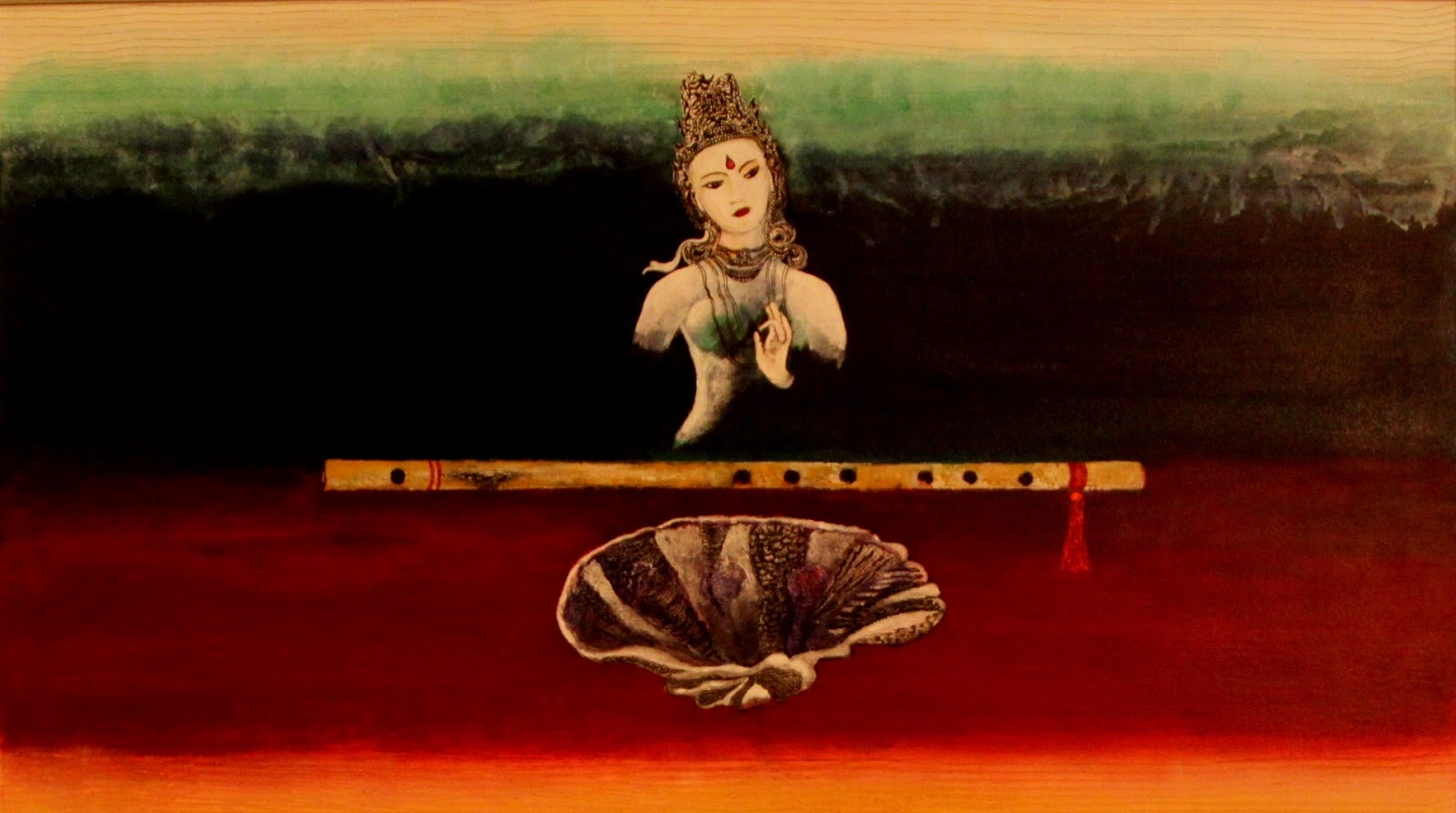
Amour
"There is only one happiness in life, to love and be loved," George Sand, the lover of Frédéric Chopin, virtuoso pianist and one of the greatest Romantic composers.

The work Amour has been inspired by the above words. Tara Devi, the Buddhist goddess of universal compassion especially popular in Tibet, Japan, Nepal and Mongolia stands central. The white Tara bestows longevity.

The scallop shell symbolises the birth of Venus, the Goddess of love. It is believed that Venus sprang from the foam of the sea atop a scallop shell. The Goddess represents passion and selfless devotion to another person. It also extends to the things that make our hearts sing, like music.

And that brings us to the third symbol, the flute. In early cultures the flute played an important role in the realm of magic and was very closely linked to the gods. For instance, the Hindu deity Krishna spread the message of love through the flute.
Acrylic and mixed media on canvas 20" X 36" /2013
Status: Acquired / commissioned work

Sunday, 15 June 2014


Sapta Ashva
A contemporary work steeped in tradition, inspired by the Surya Mantra. The work depicts seven horses in full gallop across the skies. These signify the arrival of the Sun God.  
Lord Surya or the Sun God in Hinduism is the chief solar deity and is notably mentioned as the visible form of God that one can see every day. Important scriptures and Hindu myt...hology contain several depiction of Lord Surya riding seven horses. Hence, he is sometimes referred to as Saptashva (Lord of Seven Horses). 
The horses symbolize the cosmic rays, which radiate warmth in life. As they move across the skies, they remove darkness and usher in light. The seven horses also symbolize the seven colours of the rainbow thereby bringing in good fortune and joy. In this work, therefore, the use of radiant colours for the horses, and the warm colour of the background is intended to signify this. Furthermore, with Red being the most auspicious of colours in several beliefs and regions in Asia the work takes on a significantly auspicious hue.
Acrylic on Canvas, 36" X 48" / 2012 / Framed
Status: Acquired

Thursday, 15 May 2014


Nandi, the Divine Bull 
Nandi, the white bull, is the vahana of Lord Shiva and also the gatekeeper to his abode. The work attempts to capture an unspoken spirituality and bond between the Lord and his gatekeeper, while in the background the majestic Mount Kailasa, Shiva’s abode and a sacred place for four religions: Hinduism, Buddhism, Jainism and Bön, dominates over all. Those who have visited the mountain and lake Mansarovar would surely have undergone a life changing divine and spiritual experience.
Mixed medium on paper 27" X 20" / 2011
Status: Acquired

Tuesday, 15 April 2014


Kumari 2 ( Living Goddess Kathmandu)       
From the 'Kumari' series. Inspired by the Living Goddesses of Kathmandu, Nepal and their life’s story of pride, glory, fame and sadness. The work here depicts a child Kumari, coming to terms with glory and fame, but with little awareness of what being a Kumari truly entails. The expression tries to capture  her innocence in the midst of rituals and a new found status.
Mixed medium on paper 13" X 15" / 2011
Status: Acquired

Kumari 1 ( Living Goddess Kathmandu)  
From the 'Kumari' series. Inspired by the Living Goddesses of Kathmandu, Nepal and their life’s story of pride, glory, fame and sadness. The work here depicts a more grown up Kumari, who has and is experiencing all of the above. The expression tries to capture  her expectation of the reverence bestowed upon her, based on her experience,  along with her distinct awareness of the impending end to this lifestyle and a further life of a spinster and middle class anonymity.
Mixed medium on paper 13" X 13" / 2011
Status: Acquired

Saturday, 15 March 2014


Holy Series - Benaras
From the 'Holy' series. Inspired during an early morning at the Ganga in Varanasi. This work attempts to capture the meditative stillness at the ghat. Though surrounded with bathers and others, performing early morning rituals, with the sound of temple bells in the background, the subject sits alone; introspective, silent and an island unto himself
Acrylic on paper 13" X 15" / 2011
Status: Acquired

Holy Series - Leh 
From the “Holy” series. Inspired during a cold misty morning at Leh. This work attempts to capture the austere, single minded, devotion of the monk. The early morning air is heavy with the smell of incense and the drone of low chanting notes. The cold is biting, yet the subject is in full control of his physical discomfort, obviously owing to a superior mental strength.
Acrylic on paper 13" X 15" / 2011
Status: Acquired